

Subscribe to be first in line for dahlia product sales
Subscribe to be first in line for Chinook Dahlias’ salmon‑hued signatures and rare Unicorn varieties from the US, Canada, Europe, and Australia. Expect early access to tubers, beautifully curated potted sets for effortless summer bouquets, and offerings crafted for both new and refined growers.
Shipping available within Canada only. U.S. sales from California grown dahlias expected to open in early 2027.
About Me


For thirty‑five years, I worked as a molecular ecologist studying the health and survival of wild Pacific salmon. My research focused on adaptive genetic variation and phenotypic plasticity — how organisms respond to their environments, and how those responses shape their fate. I developed non‑lethal molecular tools to measure infection, environmental stress, and disease, work that required both laboratory precision and deep engagement with the living systems I hoped to understand. But the part of my career that stayed with me most vividly happened in the field. During spawning season, we would snorkel the rivers — drifting above schools of sockeye glowing red against the gravel, watching Chinook the size of small logs hold their territories with slow, deliberate power. I was always struck by how tolerant salmon could be of other species, yet how fiercely they defended space from their own kind. And everywhere, there was color: the violet cheeks of ocean‑phase pinks, the smoky rose‑raspberry‑peach Chinook, the deep olive and copper tones of late‑stage males, the pale yellow and black contrasts of individuals carrying the white‑flesh allele. I never studied salmon color scientifically. But I lived inside it — and my understanding of genetics, physiology, and environmental modulation shaped how I saw what unfolded around me. My dahlia journey began more than twelve years ago with a bundle of tubers purchased at a Pacific Salmon Foundation auction — donated, fittingly, by another scientist who found joy in growing flowers. What started as a small experiment has grown to encompass most of my a one‑acre garden in Qualicum Beach, surrounded by coastal trees, eagles feeding overhead, and the sound of the ocean just a block away. Here, I grow varieties chosen for their resilience, rarity, and the salmon‑toned beauty that thrives in Pacific Northwest light. Over time, I began to notice something familiar. Dahlias, like salmon, are astonishingly expressive. Their colors shift with temperature, light, season, and age. Some blooms deepen in cool nights; others fade as they mature. Some plants produce flowers that vary from one stem to the next. And just as salmon populations show dramatic individual variation — shaped by genetics, environment, and life stage — so do dahlias. This website grew from that recognition: that dahlias and salmon share a kind of biological poetry. Both are shaped by genetics and environment. Both change as they move through their life stages. Both carry deep reservoirs of variation. And both reward close observation. What follows is an invitation — to gardeners, scientists, artists, and the simply curious — to explore dahlias through a lens shaped by ecology, genetics, fieldwork, and the living colors of salmon. Whether you are here for the tuber sale, the catalog, or the deeper stories behind these flowers, I hope you find something that sparks your curiosity and brings you closer to the remarkable world of dahlias. Kristi Miller-Saunders, Owner, Chinook Dahlias

Dahlias don’t just bloom — they transform. Learn how color shifts with temperature, light, and age — and how salmon inspired our taxonomy.
A Chinook Dahlias Original Framework

Morph Types
HOW DAHLIAS EXPRESS AND CHANGE COLOR
A clear, intuitive system for understanding stability, seasonal shifts, maturation changes, and pattern variation

Why Salmon?
WHAT SALMON TAUGHT US ABOUT COLOR, TRANSFORMATION, AND ENVIRONMENTAL MODULATION
How fieldwork, genetics, and environmental modulation shaped the way I see color - and why salmon became the perfect analogue for dahlias

Salmon-Dahlia Atlas
A VISUAL TAXONOMY INSPIRED BY SPAWNING SALMON AND THE EXPRESSIVE RANGE OF DAHLIAS
A color-language system that maps dahlia expression using salmon palettes, life-stage transitions, and ecological logic

Next Sale for TUBERS in December 2026
How to Shop for Dahlias (next sale December 2026)
All dahlias will show as unavailable until the Tuber Sale in December, but you can browse our collection now.
Try filtering by color palettes using our unique Salmon Atlas Zones
You can also sort by price, height, and form to find the perfect match for your garden.
How to get restock updates
Subscribers get first access to restocks through a 'Notify Me' feature on sold-out favorites. .
By purchasing, you agree to the terms of sale
Please read our guarantee and policies here. Thank you!
Explore the Collection
No availability until December 2026 - Canada Only




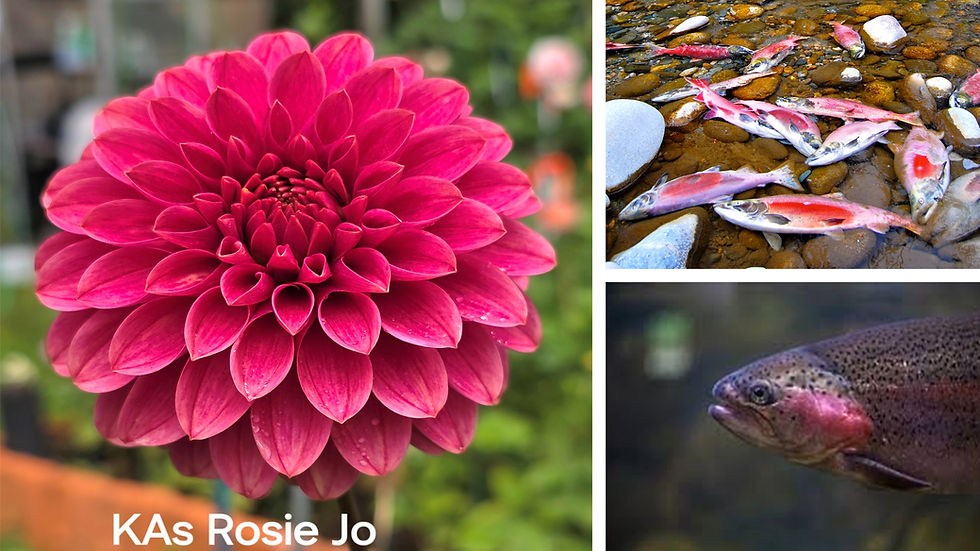


🌿 MORPH TYPE:
How Dahlias Express and Change Colour
A Chinook Dahlias Original Framework
Dahlia color is not static. It breathes, shifts, deepens, softens, and sometimes surprises — even within a single plant. New growers often wonder why a bloom expected to be pink opens yellow, or why a flower that was coral in July becomes rose‑lavender in September. The truth is simple and beautiful:
Dahlias are one of the most phenotypically flexible ornamentals on Earth.
Their colors respond to temperature, light, season, and the natural aging of the bloom. Some varieties remain steady; others are wonderfully mercurial. Understanding these patterns is the key to appreciating dahlias not as fixed color chips, but as living, expressive organisms.
This is where Morph Type comes in — a system we use at Chinook Dahlias to describe how a cultivar behaves, not just what color it is.
🌸 Why Dahlias Change Color
Dahlias are octoploid, meaning they carry eight sets of chromosomes. This expanded genome gives them:
-
enormous genetic diversity
-
flexible pigment pathways
-
high responsiveness to environment
-
a tendency toward spontaneous variation
In other words: dahlias are built for color change.
Their pigments — primarily anthocyanins (reds, purples, pinks) and carotenoids (yellows, oranges, apricots) — are sensitive to:
-
temperature (❄️cool nights deepen anthocyanins; 🔥heat can suppress them)
-
light intensity (🌤️strong sun can wash pigments; 🌥️low light can intensify them)
-
season (🍃early blooms differ from 🍂 late‑season blooms)
-
maturation (🌱→🌸pigments naturally degrade as the bloom ages)
Some cultivars have robust, stable pathways. Others are easily nudged by environment. Some have genetic quirks that make every bloom a surprise.
None of this is a flaw. It is the essence of the dahlia.
🌼 The Four Morph Types
These categories describe behavior, not judgment. Every type has its own beauty.
1. Stable
These cultivars hold their color reliably across temperature swings, seasons, and bloom age. Their pigment pathways are robust and less sensitive to environmental cues.
Gardeners love them for: predictability, consistency, and strong palette anchoring.

2. Phase Shifter
These dahlias shift color with environmental conditions — especially temperature and light.
-
❄️Cool nights → deeper, cooler, more saturated tones
-
🔥Heat → lighter, warmer, or more washed‑out tones
Gardeners love them for: seasonal drama and expressive color arcs.

3. Maturation Shifter
These cultivars change color as the bloom ages.
-
🌸Fresh blooms may be bright or intense
-
🌸Mature blooms soften, fade, or shift hue
-
🤍Late blooms may look entirely different
This is a natural physiological process: pigments degrade as the flower transitions from pollination to seed production.
Gardeners love them for: soft, romantic, watercolor‑like transitions.

4. Pattern Morpher
These dahlias show shifting patterns — stripes, streaks, splashes, or bicolor effects that vary bloom to bloom.
This behavior is often linked to:
-
transposons (“jumping genes”)
-
chimerism
-
somatic mutations
Gardeners love them for: unpredictability, artistry, and one‑of‑a‑kind blooms.


WHY SALMON?
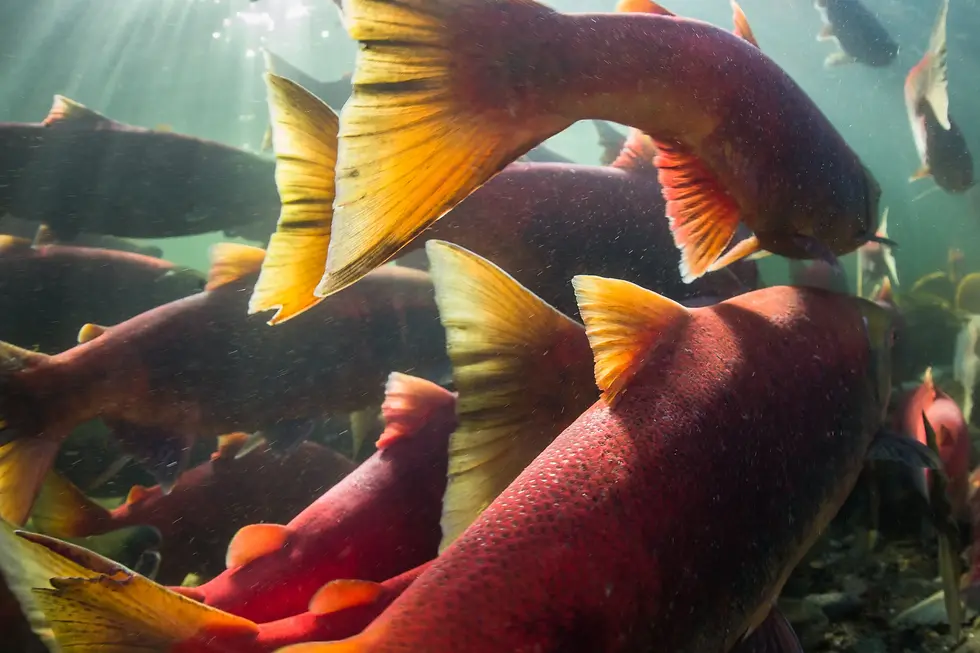
Color in nature is rarely a single hue. It is a relationship — a shifting interplay of light, translucence, saturation, and biology. Nowhere is this more evident than in Pacific salmon. As they move through their life cycle, their bodies carry entire palettes: apricot and gold glowing through alevin translucence, the rose‑peach warmth of ocean‑phase fish, the vivid coral and magenta of Rainbow Trout, the deep red of spawning sockeye, the dusky purples and burgundies of late‑season Chinook.

These are not isolated colors. They are coherent palettes, shaped by evolution, water, light, and time.
Dahlias, remarkably, echo these same palette families. Across forms and sizes, their blooms often carry the same combinations of peach, rose, coral, gold, plum, and red that appear in salmon. The parallels are so strong that once you see them, you cannot unsee them — it feels as though nature is repeating a theme.
The Salmon–Dahlia Atlas grew from that recognition.

Avenir Light is a clean and stylish font favored by designers. It's easy on the eyes and a great go-to font for titles, paragraphs & more.
Why Palettes Instead of Color Names?
Color names are imprecise. “Apricot” can mean ten different things to ten different gardeners. “Pink” can be warm or cool, dusty or electric, translucent or opaque.
But salmon palettes are specific. They are biologically grounded. They are visually coherent. And they carry emotional temperature — warmth, coolness, softness, intensity — in a way that simple color names cannot.

By anchoring dahlias to salmon palettes, the Atlas offers a way to understand color not as a label, but as a feeling.
Alevin apricot is not the same as Chinook apricot. Rainbow Trout pink is not the same as Mature Pink. Sockeye red is not the same as Coho red.
Each palette has its own mood, its own light, its own internal harmony.

Why This Matters for Gardeners
Gardeners don’t design with color chips. They design with emotion — with the feeling of a border at dusk, the glow of petals in morning light, the warmth or coolness of a cluster of blooms.
The Atlas helps gardeners::
-
cluster dahlias by natural palette families
-
see which cultivars harmonize intuitively
-
compare subtle differences within a palette
-
build gardens that feel coherent, alive, and grounded in nature
-
break the palette intentionally when they want drama or contrast
It becomes a tool for both intuition and precision — a way to design with the same logic nature uses.

Why This Matters to Me
This Atlas is the meeting point of two worlds I know deeply: the biology of salmon and the artistry of dahlias.
As a salmon scientist, I spent years studying the colors of fish — how they shift with life stage, water temperature, light, and physiology. As a dahlia grower, I found myself drawn to the same palette families in the field: the apricot‑gold of alevins, the rose‑peach of ocean‑phase fish, the coral‑pink of Rainbow Trout, the deep red of sockeye.

The more I looked, the more I realized that dahlias and salmon share a visual language.
This Atlas is my attempt to honor that connection — to give gardeners a way to see dahlias through the lens of natural palettes, and to design gardens that feel as harmonious as a river system in motion.

How to Use This Atlas
Each salmon palette is presented as a Zone, with:
-
images of salmon
-
a short, intuitive description
-
a palette strip showing the natural range
-
a few example dahlias that share that palette

Each dahlia in the catalog is then assigned one or more Zones, based on its actual collages of dahlia pictures I took and salmon pictures (mine and collaborators), not memory or written descriptions. This ensures accuracy, repeatability, and visual honesty.
The Atlas is not meant to be rigid. It is meant to be felt.
It is a guide for gardeners who want to design with the same harmony nature uses — starting with palette families, then adding contrast intentionally, rather than by accident.
THE SALMON–DAHLIA ATLAS: ZONE DESCRIPTIONS

ZONE 1 — Alevin, Flesh
Palette: Bright apricot, yolk‑gold, translucent orange, warm internal glow
Salmon Stage: Eggs and newly hatched alevins with yolk sacs, Coho salmon flesh
Mood: Luminous, tender, glowing from within
Description: Alevins carry the warm, internal light of new life — bright apricot and yolk‑gold tones that seem to shine through translucent skin. Their color is not surface pigment but a soft, inner radiance. Dahlias in this zone share that same warm glow: apricot, peach, and soft orange tones that feel lit from within, gentle yet vibrant.


ZONE 2 — Salmon Fry
Palette: Soft gold, muted olive, pale peach, gentle translucence
Salmon Stage: Fry with faint parr marks, hovering in side channels
Mood: Quiet, delicate, early‑season softness
Description: Fry carry a subtle palette — pale golds, soft olives, and muted peach tones that shimmer gently in shallow water. Dahlias in this zone share a restrained, early‑season softness: pale peaches, warm creams, and gentle blushes that feel calm and understated.

ZONE 3 — Ocean Coho
Palette: Warm apricot‑rose, coral‑peach, soft copper
Salmon Stage: Ocean‑phase coho salmon
Mood: Warm, glowing, sunlit
Description: Ocean coho carry a warm, glowing palette — apricot‑rose, coral‑peach, and soft copper tones that shimmer in moving water. Dahlias in this zone share that warmth: coral‑peach blends, soft apricot cactus blooms, and flowers that feel sunlit even on cloudy days.

ZONE 4 — Ocean Pink
Palette: Cool rose, lavender‑pink, soft blush, translucent sheen Salmon
Stage: Ocean‑phase pink salmon
Mood: Airy, cool, luminous
Description: Ocean‑phase pink salmon carry a cool, translucent rose‑lavender glow — a palette that feels light, airy, and almost iridescent. Dahlias in this zone echo that softness: white petals laced with lavender, blush blooms with cool undertones, and flowers that shift toward cream and pale pink as they mature.

ZONE 5 — Mature Pink
Palette: Dusty rose, warm pink, soft peach‑rose, muted warmth
Salmon Stage: Mature pink salmon
Mood: Gentle, warm, grounded
Description: Mature pink salmon shift into dusty rose and warm peach‑pink tones — a grounded, gentle palette with a soft matte quality. Dahlias in this zone carry that same warmth: blush‑peach blends, soft rose decoratives, and flowers that feel calm and harmonious in the garden.

ZONE 6 — Mature Coho
Palette: Copper‑rose, warm red‑peach, deep coral, earthy warmth
Salmon Stage: Mature coho salmon
Mood: Rich, warm, autumnal
Description: Mature coho develop copper‑rose and warm red‑peach tones — a palette that feels earthy, autumnal, and richly saturated. Dahlias in this zone echo that depth: warm coral decoratives, coppery blends, and flowers that glow with late‑season warmth.

ZONE 7 — Mature Sockeye
Palette: Vivid red, blue‑red, saturated crimson, green head contrast
Salmon Stage: Mature sockeye
Mood: Intense, dramatic, high‑contrast
Description: Spawning sockeye are among the most striking fish in the world — vivid blue‑red bodies paired with green heads, a palette of pure intensity. Dahlias in this zone share that drama: saturated reds, bold bicolors, and flowers that command attention from across the garden.

ZONE 8 — Post-Spawn Sockeye
Palette: Antique rose, brown‑pink, weathered tones
Salmon Stage: Post‑spawn sockeye
Mood: Soft, muted, sun‑bleached
Description: After spawning, sockeye soften into weathered rose and brown‑pink — the once‑intense reds fading into antique, almost dusty tones. Their bodies take on a sun‑bleached, desaturated quality that feels gentle and timeworn. Dahlias in this zone echo that softness: muted pinks, antique roses, buff‑pink blends, and blooms that carry a quiet, vintage warmth rather than saturation.

ZONE 9 — Rainbow Trout
Palette: Magenta, fuchsia, purple‑pink
Salmon Stage: Mature rainbow trout
Mood: Vivid, iridescent, jewel‑toned
Description: Rainbow trout flash with magenta and fuchsia along their lateral line — a vivid, jewel‑like iridescence that shifts with angle and light. Dahlias in this zone share that electric energy: bright magentas, purple‑pinks, and saturated fuchsias that feel almost luminous. These are the show‑stoppers of the cool‑tone spectrum, glowing even on cloudy days.

ZONE 10A— Mature Chinook (wild-type)
Palette: Smoky raspberry‑rose, muted coral, warm rose‑gold, deep peach‑rose
Salmon Stage: Mature Chinook salmon — wild‑type coloration
Mood: Smoky, warm, richly complex
Description: Wild‑type mature Chinook show a remarkably warm and smoky palette: raspberry‑rose along the flanks, muted coral and deep peach‑rose across the body, and a soft rose‑gold glow that shifts with light, temperature, and river conditions. Their coloration is dense, warm, and full‑bodied, with subtle internal luminosity rather than sharp contrast. Dahlias in this zone mirror that richness — smoky corals, raspberry‑rose blends, warm peach‑rose tones, and blooms that feel saturated, glowing, and quietly complex. These are the deep, warm anchors of the salmon spectrum, defined by their steady, full‑bodied color rather than dramatic contrast.

ZONE 10B — Mature Chinook (white flesh variant)
Palette: Pale yellow, cream, soft gold contrasted with black, near‑black, or deep charcoal
Salmon Stage: Mature Chinook salmon — white‑flesh phenotype
Mood: High‑contrast, graphic, dramatic
Description: A small but distinctive subset of mature Chinook carry the white‑flesh phenotype, producing bodies that shift toward pale yellow, cream, or soft gold while the head, bars, or dorsal region darken into deep charcoal or near‑black. This creates a striking, high‑contrast appearance unlike any other Pacific salmon. Most dahlias in this zone echo that graphic contrast: pale yellow or soft gold petals paired with black or near‑black centers, streaks, or reverse petals. Others simply reflect the soft gold hues from the body or pale salmon to white flesh. Many of these blooms feel bold and architectural, with a clean, dramatic tension between light and dark that sets them apart from the warmer, more variable tones of Zone 10A.

ZONE 11 — Mature Chum
Palette: Olive green, muted dark red bars, earthy tones
Salmon Stage: Mature chum
Mood: Woodland, earthy, graphic
Description: Mature chum develop striking vertical bars of muted red over olive‑green bodies — a woodland palette unlike any other salmon. The contrast is earthy, graphic, and unmistakable. Dahlias in this zone echo that grounded palette: olive‑infused reds, earthy tones, muted brick, and blooms with unusual green undertones or smoky red‑brown depth.

ZONE 12 — Light-Reflective Mature Sockeye
Palette: Red‑coral, gold
Salmon Stage: Light‑reflective mature sockeye
Mood: Bright, reflective, sun‑lit
Description: Some mature sockeye take on a luminous, light‑reflective quality — red‑coral bodies glowing with golden highlights where sunlight hits the scales. It’s a brighter, more reflective version of the classic sockeye red. Dahlias in this zone share that radiance: coral‑reds with golden undertones, warm glowing blends, and blooms that seem to hold light within their petals.
Our Guarantee
At Chinook Dahlias, we take pride in sending out healthy, high‑quality tubers and plants. Every tuber is inspected for at least one viable eye, and all dividing tools and cutting instruments are sanitized using professional‑grade protocols to reduce the risk of pests and disease. We guarantee that your tubers will arrive in good condition and true to variety, and we will work with you if something is not right upon arrival.
Because dahlias are living organisms influenced by storage, weather, soil, and care, we cannot guarantee performance under your overwintering conditions, or in spring, once tubers are planted in your own garden. However, in the very rare case of a misidentification, we will replace with the variety that you purchased in the following year.
We guarantee that what we send you has been grown, handled, and inspected with the same care we give our own plants.

🌿 Chinook Dahlias — Terms of Sale
At Chinook Dahlias, every tuber and plant is prepared with care and inspected before shipping. Because dahlias are living organisms that respond to storage, environment, and handling, the following terms help ensure a fair and transparent experience for all customers.
Tuber Quality & Inspection
-
All tubers sold by Chinook Dahlias are inspected for at least one viable eye before shipping. In winter shipping, tubers will have an eye, but not necessarily a but, but in spring shipping, we only send out tubers that have been "woken" up with a bud/sprout. Buyers need to be aware of this before deciding when they want tubers shipped.
-
Tubers naturally vary in size, shape, and appearance. Large or small, both can be equally viable when stored properly.
-
Some varieties produce slender or unusually shaped tubers; this is normal and not considered a defect. We will do our best to note those varieties so buyers can make informed decisions.
Sanitation & Disease Prevention
Chinook Dahlias follows strict sanitation protocols to protect against pests and disease. All tools used for cut flowers are disinfected with Virkon, and instruments used for dividing tubers are sterilized using bleach or Virkon, followed by alcohol and flame to ensure complete decontamination. Plants that fail to thrive or show abnormal leaf patterning suggestive of viral infection are immediately isolated or culled to prevent spread. While crown gall is extremely rare on the farm, any plant showing symptoms—along with the surrounding soil—is removed and disposed of off‑property or burned, never composted. These practices help maintain a clean, healthy growing environment and reduce the risk of transmitting pathogens through tubers or plants.
Customer Inspection Upon Arrival
Customers must inspect their tubers within one week of delivery.
If you have concerns about the condition of your tubers, you must:
-
Contact Chinook Dahlias within 7 days of receiving your order.
-
Provide a brief description and photos of the issue.
-
For dahlias over $25, tubers that are considered unsatisfactory must be shipped back in that 7-day window, and if available, replacements will be made or money will be refunded.
Unless there are extenuating circumstances, after the 7‑day window, tubers are considered accepted and in the customer’s care.
Returns & Refunds
-
Returns are accepted only within the 7‑day inspection window and only after contacting Chinook Dahlias.
-
Refunds or replacements will be issued once (high value) tubers are returned and inspected, or photos and provided outlining issues with tubers <$25 in value.
-
Shipping costs are non‑refundable.
-
Chinook Dahlias does not offer refunds for tubers that fail due to improper overwinter storage, handling, or growing conditions after arrival.
Storage Responsibility
Once the 7‑day inspection window has passed, all responsibility for proper storage, starting, and growing rests with the customer.
This includes:
-
maintaining appropriate winter storage conditions
-
protecting tubers from freezing or excessive heat
-
ensuring proper soil, watering, and planting depth
-
managing pests, disease, and environmental stress
If you are unsure about your winter storage conditions, please do not select the winter shipping window, as tubers will require safe storage until planting time.
Shipping Windows
In 2026/2027, Chinook Dahlias plans to offer two shipping windows:
-
December (limited early shipping)
-
Late April / Early May (standard shipping for most customers)
Customers may select their preferred window at checkout. If no window is selected, orders will ship in the standard spring window.
Plant Sales (May)
Potted dahlias sold in May will only be available to local clients, as we do not ship potted plants.
Because these are live plants:
-
They cannot be returned once shipped
-
Refunds are not offered for plants damaged due to delays in planting, improper care, or environmental conditions after pick-up.
Weather Holds
Chinook Dahlias may delay shipping during periods of extreme cold or heat to protect your order. Customers will be notified if a weather hold affects their shipment.

Shipping Info
TUBERS
December Shipping Window
For growers who like to plan ahead or start indoors, a limited number of tubers will ship in mid–December. This window is ideal for those in warmer climates or anyone who prefers to receive tubers to start for cuttings over winter.
Standard Spring Shipping (Default)
All other tuber orders ship in late April to early May, when weather is more stable across Canada and the northern U.S. This is the safest window for most growers and the default for all orders unless a December window is selected at checkout.
POTTED DAHLIA PLANTS
For local growers in British Columbia who want a jump‑start on the season — or who prefer not to handle tubers — Chinook Dahlias will offer a limited May sale of plants started from tubers.
-
In-Person pickup in Qualicum Beach or Vancouver select dates
-
These plants are ready to go straight into the garden for summer blooms
This option is perfect for new growers, busy gardeners, or anyone who missed winter tuber sales, but will contain a more restricted number of varieties than available in our tuber sales.
Combined Orders
If you purchase tubers in more than one order and select "combine orders", we will try to accommodate combined shipping if there is at least a 1-week window before the order is to be shipped.
Weather Holds
To protect your plants and tubers, Chinook Dahlias may delay shipping during periods of extreme cold or heat. You will be notified if a weather hold affects your order.